
Good morning, party people. Found a little bit of news for you so you have something to talk about if anyone you don’t like corners you in the break room later.
In this news brief
KPMG May Have Been Less Than Forthcoming
Financial Review started their week putting KPMG on blast, as one does: KPMG’s half-hearted disclosures skewed Ashurst review of misconduct.
KPMG withheld crucial information from Ashurst as the law firm conducted a review related to allegations of misconduct in the accounting firm’s audit division, leading the lawyers to dismiss the whistleblower’s right to claim legal protection.
A report authored by Ashurst in May last year said KPMG had told the law firm that the whistleblower had only provided “high-level information” about the allegations. This prompted Ashurst to find that he had not provided sufficient detail for his claims to qualify as protected disclosures.
And:
The reports show that KPMG provided such limited information to Ashurst that the law firm concluded that the firm could not investigate the whistleblower’s claims due to a lack of detail, and accepted that the auditing giant had reviewed the allegations and found them to be false.
Earlier coverage that goes over Ashurst findings: Ashurst warned KPMG of Lendlease breach ‘risk’ last August
NYT on B4’s Hottest Tax Strategy
New York Times wrote about Crocs. Well, they wrote about Crocs’ tax strategy and how Big 4 firms are the reason the NYT’s reporter struggled to find actual corporate offices when he visited the country for this story:
Take the stairs to the second floor of an old brewery on the Mediterranean archipelago of Malta and buzz yourself in to a tiny office hidden behind a heavy metal door.
The air smells of hops, but this place isn’t just brewing beer: It’s the headquarters for a convoluted strategy that the world’s biggest corporations use to dodge billions of dollars in U.S. income taxes.
Consider Crocs. One of the world’s most profitable shoemakers sells its signature chunky clogs to 150 million customers across 100 countries annually. Yet, come tax season, the Broomfield, Colo., company has claimed that all its global profits were actually earned in this two-person office.
Welcome to Malta. The tiniest country in the European Union, with roughly the population of Milwaukee, it is home to turquoise water beaches and a raging nightclub scene. It is also the world’s hot new corporate tax haven.
Here comes the meat:
The accounting firms KPMG, PwC, Deloitte and EY are aggressively marketing the strategies that Crocs and other companies are using to push profits to Maltese units with ghost offices and no employees. A KPMG presentation reviewed by The New York Times laid out a byzantine arrangement for prospective clients to slash their tax bills by arbitraging U.S. and Maltese rules.
“The choreographers are the Big Four,” said Michael Hamersley, a former tax lawyer at KPMG and EY. “They seek out the opportunity to exploit the tax system.”
Well yeah? That’s what clients pay them the big bucks for.
I’m curious if this story takes off or if it gets buried under a mountain of news slop.
Who Need Consultants Anyway?
Financial Times opinion pages asking the serious questions: Who needs consultants in the age of AI?
Writes Robert Armstrong:
In the age of artificial intelligence, what happens to people who sell the human variety? It’s a pressing question for a lot of professions (not least opinion writers), but is especially acute for strategic consultants, who not only sell ideas but charge a lot for them. In other professional services industries such as law and accounting, the provider is paid in part for taking on legal responsibility. Someone has to sign off on accounts or legal opinions, whether they were drafted by an AI model or not. Strategy advice lacks this virtue. It’s simply good or bad, useful or pointless. If a large language model can do it better, faster or cheaper, we should use the model and fire the consultant.
The piece goes on to talk about how consulting isn’t just about ideas, it’s about being able to push the client past the point of transformation.
Still, lots of clients are asking that very question these days.
CPAB Gets Around to Punishing EY For Cheating
In Canada, the Canadian Public Accountability Board is bringing up old shit. Rather, they’re wrapping up some aged cheating allegations. Reports Canadian Accountant:
Four years after saying it would investigate whether employees at Ernst & Young LLP cheated on exams and training courses, the Canadian Public Accountability Board has announced a settlement with EY Canada. This past week, CPAB published an enforcement order against the Big Four firm, one that includes an undisclosed monetary assessment to be paid by EY Canada to CPAB to cover the cost of monitoring the accounting firm’s compliance.
The important bit:
According to the 17-page enforcement order, accountants at EY Canada cheated on EY Learning Courses from at least 2017 until the second half of 2020, a period of at least three years (incidents of answer sharing also occurred in 2014-2016, however, the Investigation did not focus on that time period).
You may remember a headline from four years ago that took precedence over any happenings in Canada: EY Auditors Cheated on Ethics Exams and Tried to Cover It Up, Will Pay a Record Fine for Naughtiness. And a follow up we did: How Exactly Did EY Auditors Cheat on CPE Exams? Details From the SEC Order
Speaking of cheating, is the PCAOB done fining big firms in foreign countries for sharing answers? It’s looking like it. Sharing answers is out, AI cheating is in!
Tax and Finance Leaders Are Sweating Tax Complexity
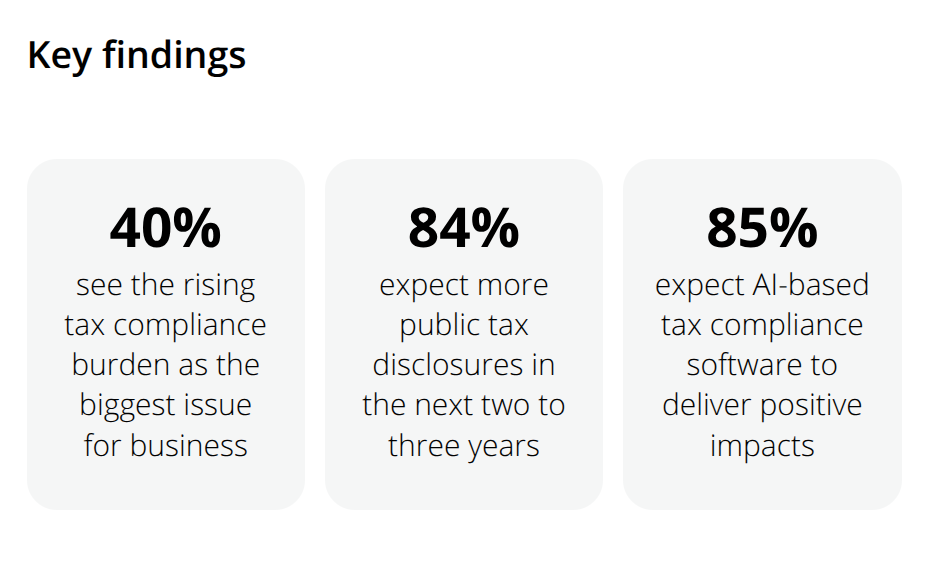
You internationally-minded tax nerds out there will like this one from Deloitte, it’s their 2026 Global Tax Policy Survey. They surveyed 1,010 tax and finance leaders across 28 jurisdictions and found that tax complexity is the top issue affecting global tax and finance leaders in 2026.
There’s Levels to This
Aprio made a new commercial, the spot is called Levels and they’re running it in the Washington, DC market to start.
And before you spend all afternoon AI-vestigating, yes AI was used to make this in some capacity:

Did the set make anyone else think of this?
That’s it for this news brief. As always, I invite you to email or text the tipline if you have a tip or story for us. Don’t worry if you think we may have seen it already, we’re not like Flock with eyeballs everywhere and appreciate all scoop even if it’s not fresh.
Alright, go out there and have a good week or else.