So Elon Musk just xeeted this, what do we think?
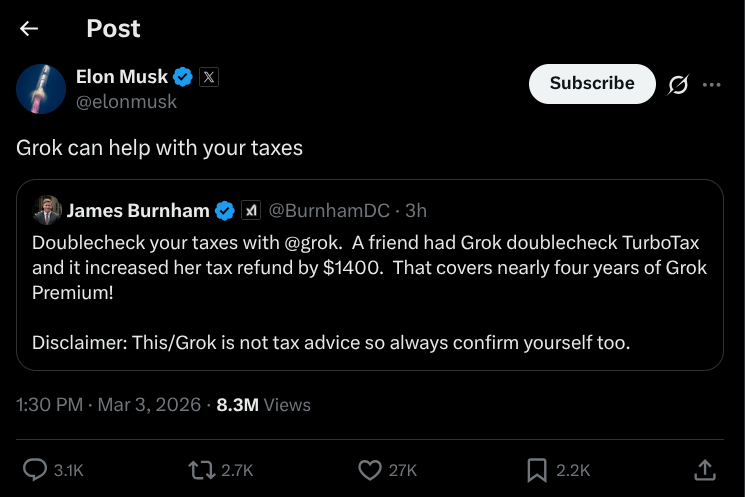
So Elon Musk just xeeted this, what do we think?

Every tax professional has run across questionable expenses provided by their clients. Maybe you’ve got a used car-lot proprietor who insists that his hairpiece is crucial to his business appearance and, thus, his ability to put people behind the wheel of their dream ride. Perhaps you’ve got a sociologist that is conducting weekly research in the champagne room of a local gentleman’s club. Or maybe you’ve recently concluded that the process of, and expenses related to, tying the knot have been such a burden that it is completely acceptable to ram it onto your 1040:
Dear Caleb,
I have now figured out why the divorce rate is so high in America. Apparently, according to one of my taxpayers, wedding expenses and cruises for celebrating your engagement are now considered “write-offs.” Unfortunately, I cannot find this particular subject in THE CODE – but I think I’ll take my taxpayer’s word for it.
Maybe you should pass on this tidbit – I sure wish I had known about this obscure write off before I got married, but obviously, it’s time for me to start planning my next one. It’s going to be HUGE!!
– One of the many tax preparers currently wishing they remembered what their home looks like.
Our tipster insists that her client provided the receipts but didn’t want to forward them (something about client confidentiality). Of course, if you’ve got something that tops this, you’re invited to share it with us. In the meantime, any tax sages out there that wish to advise/debate the credibility of including the cost of sheet cakes from Costco, amateur photographers and invitations that may or may not kill you on a Schedule A (or wherever) are free to do so.
As soon as you catch your breath from laughing hysterically, feel free to continue.
Max Baucus turns 59 69 on December 11th, so even if you assume that he will have the life expectancy of Robert Byrd that means he’s got 32 22 years of watching the IRS’s every move. Sure, we’re making the assumption that the IRS has a snowflake’s chance in Hell of closing the tax gap but that’s an assumption we’re comfortable making.
The General Accounting Office recently stated that the IRS was using “antiquated techniques” to fight tax evasion and Baucus feels compelled to be on top of the situation until the tax gap is a distant memory.
“This report makes clear the IRS needs to develop a comprehensive strategy to fight complex tax evasion schemes and that more work is needed to close the tax gap,” Baucus said in prepared remarks. “I intend to closely monitor the IRS’ progress to make sure they have an effective strategy to root out this tax evasions and close the tax gap once and for all.”
You may now resume laughing until you soil yourself.
Baucus urges new strategy for IRS to combat evasion [On the Money]
The former head of the Iowa Film Office was charged this week with “unfelonious misconduct in office” for his role in a scandal in which filmmakers bought themselves everything from featherbeds to Benzes with money advanced by the taxpayers of Iowa.
The Hawkeye State fell big time for the film credit fad that swept the country in recent years. Iowa had two 25% tax credits, one for filmmakers and one for investors. As interpreted by Mr. Wheeler (but not the Attorney General), the credits together could add up to 50% of film costs incurred in state, making it perhaps the most generous such giveaway in the country.
Better yet, the credits are transferable, so filmmakers can sell them at a discount to raise money. The program had no caps, meaning that Iowa could give away money as fast as Hollywood could spend it.
The entire program was managed by Mr. Wheeler, almost by himself. And did he ever manage it. According to the Iowa Attorney General:
Defendant Wheeler permitted filmmakers… to utilize “payments in kind” including “services in kind” in support of claimed expenditures for tax credits. Under defendant Wheeler’s direction, Iowa’s film program became one of the few, if not the only, state film incentive program in the nation to allow credit for “services in kind.”…Examples included “sponsorship agreements” in which intangible assets (such as reciprocal web links, product placement and marketing agreements) were traded with no money changing hands. These non-cash “expenditures” sometimes constituted the majority of the filmmakers entire alleged budget.
For a brief glitzy moment, Iowa was overrun with film crews and starlets helping themselves to a bountiful harvest.
The party ended last fall with revelations that Iowans helped buy a Mercedes and a Land Rover for a producer via film credits. Mr. Wheeler lost his job, and now he stands charged with a “serious misdemeanor.” Two filmmakers are charged with felony theft for inflating their expenses while claiming credits.
But if Mr. Wheeler is criminally inept, what about the bosses that left him alone and unsupervised to give away over $30 million so far? And what about the 147 legislators — out of 150 — who thought it would be a good idea to give Hollywood a blank check? And you thought “Music Man” was fiction.
But lest you think too badly about the rubes in Iowa, forty-four states are giving taxpayer money to Hollywood. Chances are that your legislator is taking money from you and giving it to those nice Hollywood people. Remember that next time your legislator says you aren’t paying enough taxes.
Comments are closed.

What a Crock to have Grok! If you have W-2 and one 1099-INT – great, but let’s see it figure out accrued tax exempt bond interest for a nonresident state which is not on the 1099; decide what is allowable for an expense on Schedule C and categorize it. Let’s see it correctly prepare a reverse Starker transaction. Puh-leese…. CPAs will not be replaced any time soon. Simple returns – sure – try it, but I certainly will not rely on Grok’s knowledge of IRS Tax code, regulations, Rev. Procs. and Rev. Rulings. Unfortunately, naive people will rely heavily on these and other AI iterations and pay money for no good reason.