

Hey. I dug up some news to start your week.
In this news brief
- Hey Knicks Fans, Know Your KPMG History
- AI Compute Taxes: The Hot New Debate
- Volunteer Tax Prep Loses a Real One
- That CPA Pathways Thing Really Took Off Didn’t It
- One of Us, One of Us
- This is For the Two of You in the Audience Who Care About This Stuff
- Guy Forces Himself to Be Retired From Tax Prep in the Worst Way Possible
Hey Knicks Fans, Know Your KPMG History
Jarrett Kalish and Nicholas Combs of Kalish Law LLC discuss the skybox at Madison Square Garden and how Peat Marwick Main & Co fought for its tax treatment in Bloomberg Tax:
As the New York Knicks prepare to square off at home for Game 3 of the NBA Finals, quietly standing in the background is another one of the city’s most enduring institutions: the commercial rent tax, or CRT.
Following the Knicks’ last championship victory in 1973, accounting firm Peat Marwick Main & Co.—a predecessor to what is now KPMG—entered into a series of agreements with Madison Square Garden that entitled the firm to use a luxury skybox suite for all ticketed events held at the arena.
The New York City Department of Finance in 1987 determined that the firm owed the city’s CRT on the payments that it made to MSG to use the suite. Peat Marwick challenged the city’s application of the tax and won [PDF], allowing firms today to host events at MSG without the need to file a tax return.
What appeared to be a straightforward agreement to entertain clients ultimately produced one of the most important CRT decisions ever issued. The case serves as a reminder that tax outcomes often turn not simply on the activities engaged in, but on how those activities are characterized under the law.
AI Compute Taxes: The Hot New Debate
The Information Technology and Innovation Foundation (ITIF) argues the case against taxing AI compute in “Taxing AI Compute Would Be a Mistake“
The article’s four main points:
- First, a compute tax would slow the productivity gains AI can deliver.
- Second, a compute tax would push investment and innovation abroad, weakening U.S. AI leadership.
- Third, a compute tax would do little to preserve the tax base.
- Fourth and finally, a compute tax would not help solve a mass unemployment problem AI is unlikely to create.
WSJ wrote a pretty in-depth piece about AI compute taxes and why the idea is gaining popularity in some circles on May 6:
Advocates support an AI tax to make up for potentially massive job loss and to slow AI’s extreme growth rate.
“We’re at a point now where we need to try and preserve jobs,” says Andrew Yang, a former presidential candidate and a co-chair of the Forward Party. “AI is going to gut white-collar employment and then by the way, it’s going to proceed to truck driving and a lot of other very common jobs.” Yang has long supported a so-called universal basic income.“If you look at the taxes that are being paid by the biggest AI companies, they’re nowhere near commensurate to the value that AI is going to end up both generating and soaking up,” he adds.
Volunteer Tax Prep Loses a Real One
The local news profiled a wonderful woman in Mahomet, Illinois who spent almost three decades as a volunteer tax preparer:
Brenda Farney is as comfortable with numbers as fish are with water.
So much so, that every job she ever worked always calculated numbers, and when she saw a newspaper ad seeking a volunteer tax worker, she jumped at the chance — but she is venturing into different bluer waters having retired from being an AARP tax volunteer local coordinator for the last 28 years at the Mahomet Public Library.
“I enjoy numbers, that’s the bottom line,” she said.
“I always seem to gravitate toward things that involve numbers.”
That CPA Pathways Thing Really Took Off Didn’t It
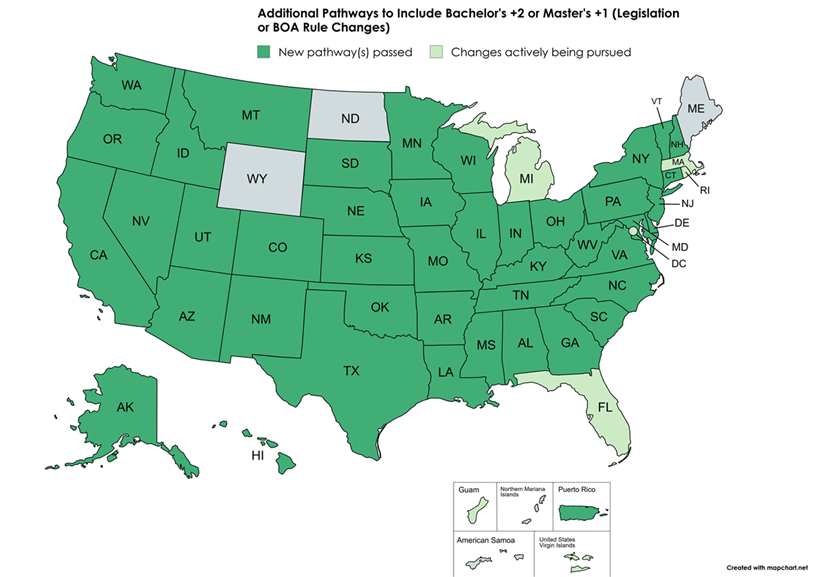
Vermont, Missouri and Louisiana are close to having new CPA pathways, soon to join the more than 40 states that have already passed legislation.
MNCPA’s map, last updated a few days ago:
One of Us, One of Us
ICYMI: PCAOB chairman Jim Logothetis delivered some remarks at the USC SEC Financial Reporting Conference on Thursday. He started things out by repping the CPA squad:
I am proud to serve as the first permanent Chairman of the PCAOB who has public company audit experience, and I place a great deal of importance in the CPA designation. In fact, two-thirds of the professional staff in my office are CPAs.
Under this Board, the PCAOB will value and consider the experience of the professionals who intimately understand this work and the responsibility because they have lived it.
I spent more than four decades in the audit profession. I dedicated my entire career to it. So, I understand the pressures, the judgment calls, the complexity, and the stakes. The work of leading the PCAOB requires someone who can challenge the status quo while also respecting those in the profession who appropriately view their role as aligned with our own—protecting investors.
I bring that balance to this role, and that is why I believe the PCAOB is ready for its next chapter.
Can we trust this brings an end to the PCAOB fining European firms for sharing answers on internal training when there are surely better things to do?
This is For the Two of You in the Audience Who Care About This Stuff
Treasury and the IRS have issued a notice regarding tax-exempt organization executive compensation:
The Department of the Treasury and the Internal Revenue Service today issued Notice 2026-36 [PDF] announcing intent to issue proposed regulations addressing the tax on excessive compensation and excess parachute payments to employees of tax-exempt organizations under the One, Big, Beautiful Bill.
“The new law strengthens the accountability of tax-exempt organizations by expanding tax compliance requirements for certain organizations paying excessive compensation and excess parachute payments to their executives,” said IRS Chief Executive Officer Frank J. Bisignano. “It broadens the scope of tax from a limited group of executives to potentially any highly compensated employee.”
Guy Forces Himself to Be Retired From Tax Prep in the Worst Way Possible
In Accountants Behaving Badly news, we have one guy who’ll never work in this town again:
A veteran Southern California accountant has admitted to running a massive, years-long tax fraud scheme that fabricated thousands of business losses, charitable donations, and green energy credits to land illegal refunds for his clients.
Oladapo Olagbemi, 72, pleaded guilty in federal court to four counts of aiding and assisting in the preparation of false tax returns. As the owner and manager of San Diego-based D.A.O. Accounting, Consulting, and Taxation, Olagbemi manufactured more than $5 million in improper deductions and credits between the 2019 and 2023 tax years, according to prosecutors.
The longtime certified public accountant signed his plea agreement shortly before Tax Day, on April 15, 2026. He now faces a permanent ban from the tax profession and a looming prison sentence.
He evidently was a big fan of Form 2106.
K that’s the end of that. Should you have a story or tip for us, please email or text anytime. Tipsters are anonymous (and appreciated), always. Go forth and account.