

So CPA Journal ran an interesting article recently titled “Intergenerational Solutions to Address the Crisis of the Leaking Accounting Pipeline.” Now, “interesting” is an adjective up for debate but for academics and the people who love their hyperfixations on certain topics near and dear to their scientific little hearts (me), we can at least recognize that sometimes their papers hit at the heart of issues that affect public accountants at large. That’s what this article is about.
Their article, like all CPA Journal articles, is long and filled with tons of references. Since I know that sort of deep dive doesn’t do well here, I’m going to focus instead on a single paper referred to within and, more specifically, a single chart from that single paper.
The paper is Attracting Millennials: Legitimacy management and bottom-up socialization processes within accounting firms, authored by Sylvain Durocher, Merridee Bujaki and François Brouard and published in Critical Perspectives on Accounting, 2016, vol. 39, issue C, 1-24. You, like us, may have missed this one when it dropped ten years ago. They really should publish these things in convenient back-of-the-toilet reading basket form like grandma’s old Reader’s Digests, they might get some more eyeballs on them.
The abstract, if you want it:
The competition to attract trainee accountants is fierce among accounting firms. Millennials seemingly have expectations in terms of work experiences and work environments that arguably cannot be ignored by accounting firms. This paper draws on a legitimacy framework to examine legitimacy management strategies utilized by large Canadian accounting firms in website communications directed at future employees. Our results demonstrate accounting firms appear to devote considerable effort to manage their legitimacy in the eyes of prospective employees and apparently use website communications to depict a work environment largely in accordance with Millennials’ system of values and beliefs. This suggests a bottom-up socialization process is taking place whereby accounting firms adapt the workplace in response to future employees’ expectations. Interviews with partners, managers and human resource advisors working in accounting firms support the idea of a bottom-up process. We conclude a two-way socialization process exists, where the firms and the new employees are both instigators and targets of socialization, jointly influencing what it is to be an accountant today.
And what CPA Journal had to say about this dusty but still relevant paper:
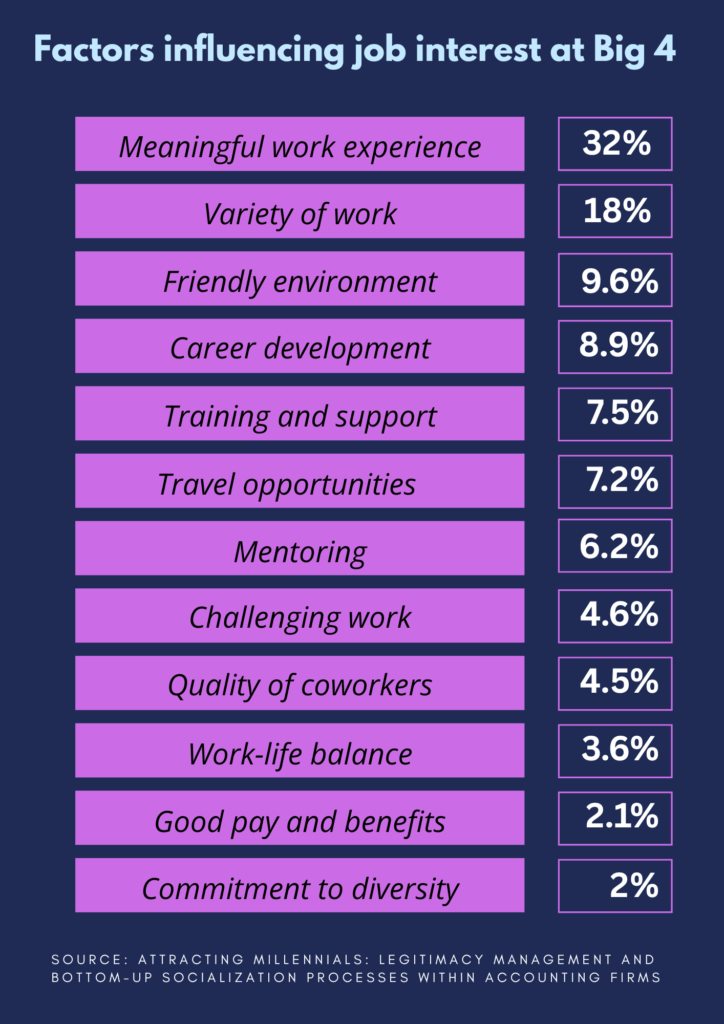
Within the context of accounting recruiting practices, Durocher, Bujaki, and Brouard examined the legitimacy of recruiting tactics, with legitimacy defined as matching Millennial applicant preferences in their website content (“Attracting Millennials: Legitimacy Management and Bottom-Up Processes Within Accounting Firms,” Critical Perspectives on Accounting, vol. 39, pp. 1–24, 2016). Durocher et al. examined web content for the Big Four and Next Four in Canada and demonstrated that (as expected) legitimacy mattered to applicants. As seen in Exhibit 2, firms focused their web content first on highlighting meaningful work experiences, followed by career development opportunities, and the firm’s commitment to diversity. Training, development, and support were identified as important, along with teamwork, a friendly environment, and the quality of co-workers. Work-life balance was evident on about 3% of web pages. These results help recruiters understand how Millennials assess legitimacy as part of their employment search process and can inform messaging and culture-building tactics, reinforcing that applicants want to see and experience these factors when assessing their career moves.
So as you can see, the researchers looked at accounting firm recruiting from the firms’ own websites, specifically the careers sections. And although the paper completely acknowledges that work-life balance and pay are critically important to millennials, what they found was that Big 4 and “Next 4” firms in Canada highlighted other factors a whole lot more.
CPA Journal made a chart but it was kind of dull and just screenshotting it seemed a little lazy so here’s ours below (theirs is the Exhibit 2 referenced in the article snip above). What it shows is how often these topics appeared on Big 4 career pages analyzed by the researchers, meaning “meaningful work experience” got a ton more lip service than the important ones like pay and work-life balance. And we wonder why interest in the profession has been waning.
Remember, this isn’t “32% of millennials care about meaningful work experience when considering which Big 4 firm to work for,” it’s “this is how frequently Big 4 firms (in Canada) mentioned these factors on their careers pages.”
I really wish there were some screenshots in the original paper, I would love to see how Big 4 firms in Canada addressed “quality of coworkers” in 2016. I’m sure what I’m imagining in my head is way funnier than what it actually looked like.
The researchers were pretty kind in how they described firms’ unwillingness to advertise salaries. A more cynical view, which we’re always happy to provide, would be that they try to obfuscate this on purpose and instead dance around qualities that a bunch of boomers decided matter to millennials:
Millennials often have high expectations in terms of remuneration and benefits (Ng et al., 2010). Although accounting
institutes publicize members’ average remuneration levels by sector (see for instance Picard et al., 2014’s study of the Ordre
de comptables agréés du Québec), accounting firms are much more discreet about their employees’ remuneration. Firms tend
to manage exchange legitimacy by emphasizing the competitive nature of the salaries and performance bonuses they offer.
We find that Next Four firms devote a slightly larger proportion of their web communications than Big Four firms to this
issue, maybe to suggest they can compete with Big Four on this matter.
So what happened? Did people accept this “discretion” as part of the game and let firms continue to be shy about pay? Yeah, no. Thanks to the internet, entire communities sprouted up around the topic of salaries and benefits at accounting firms. This website you’re reading right now grew exponentially in the late 00s and early ’10s when we’d run our yearly compensation threads. Every year, Big 4 staff contribute to giant, semi-public spreadsheets where they share raises and promotions. Websites like Big4Transparency collect and disseminate this information, freely and easily.
Naturally, this eagerness on the part of public accountants to share their salaries with each other because firms weren’t putting it out there then led to these communities becoming a virtual watercooler around which public accountants could discuss more than just money. Work-life balance. Expectations. Gossip. Perhaps this would have happened regardless of whether or not firms put salary info out there, who can say. But we do know that salary was the linchpin that united accountants across experience levels and service lines, and that part of that early eagerness to share this information amongst themselves sprung from frustration with the lack of salary transparency on the part of firms.
And you know what? The Powers That Be hate that they’re no longer in charge of the narrative. See also: Quote of the Day: ‘The Message Conveyed is That Firms Will Work You to Death with Minimal Pay Increases’
Maybe they should have just been upfront about it from the beginning.
