

After several years of inspection reports full of deficiencies and many attempts at public shaming to get firms to focus on audit quality that culminated in a scathing op-ed in WSJ penned by the now-departed PCAOB chair, Big 4 firms can finally say they’ve got things back on track. The track being the PCAOB’s checklist of checklists, that is.
The PCAOB dropped six big inspection reports last week: BDO USA, Deloitte, EY, Grant Thornton, KPMG, and PwC. For this article we’re focusing on Big 4, we’ll do those other two in a separate article. For the record, those other two had deficiency rates in the 30s while the three of the four Big 4 came in at single digits.
If you’re interested in more historical data, definitely check out this article by Richard Palmer, PhD, CPA for CPA Journal. The chart below shows that Big 4 firms had been on a slow deficiency slide throughout the 2010s then rocketed back up when we hit the dreaded 2020s:
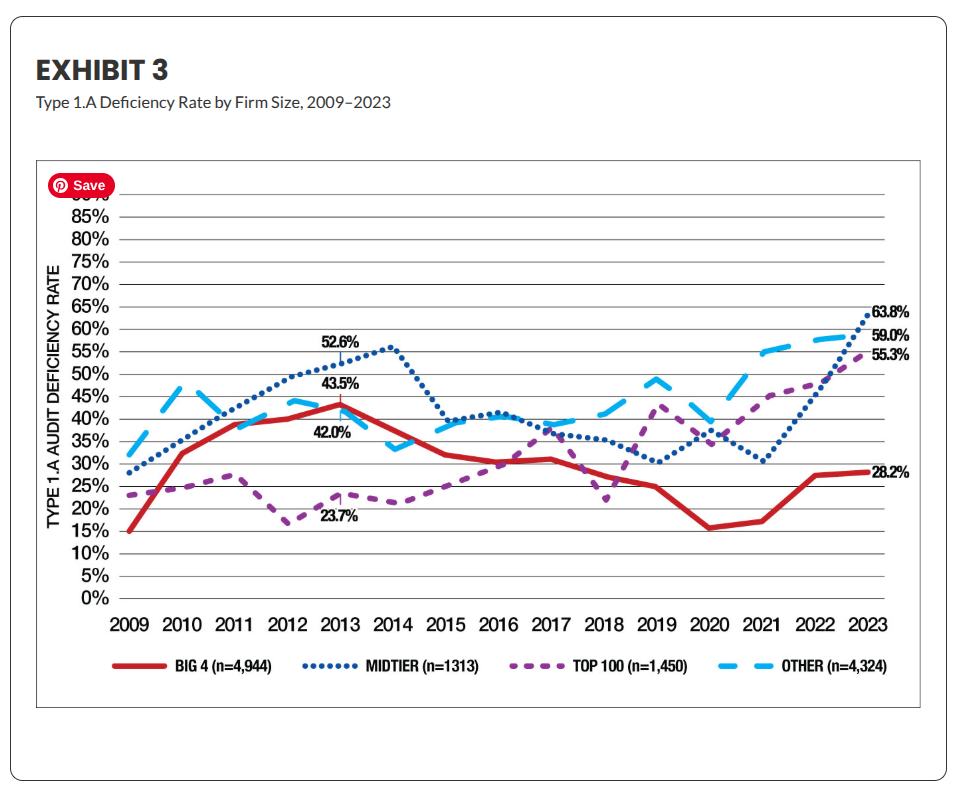
Things continued to suck but now that we’re midway through the decade, it appears firms have figured out how to audit to the PCAOB’s satisfaction once again.
TLDR: For their 2025 PCAOB inspection reports, Deloitte and EY came in at a 5% deficiency rate, PwC got 9%, and rounding out the bottom as usual was KPMG at a still respectable 13%.
We don’t need to dive too deep into individual reports because no one cares but those much lower deficiency rates are something worth discussing. Those of you eager to suggest conspiratorially that the numbers have been fudged due to foxes being in charge of the henhouse will need to reserve those comments for next year’s inspection reports as those appointments were made earlier this year and therefore weren’t in effect during the 2025 inspection cycle.
The category for Most Improved has got to go to EY, who climbed their way to 5% from an all-time high of 46% in 2022. Quite naturally, they bragged about this and made a pretty chart for their most recent audit quality report:
We are proud to announce that our transformation is already having a significant positive impact on our audit practice. The Public Company Accounting Oversight Board (PCAOB) recently issued our 2025 inspection report, which shows that the percentage of audits in which the PCAOB identified a Part 1.A finding improved dramatically to 5% from 28% in 2024. These results are the best we have ever had.
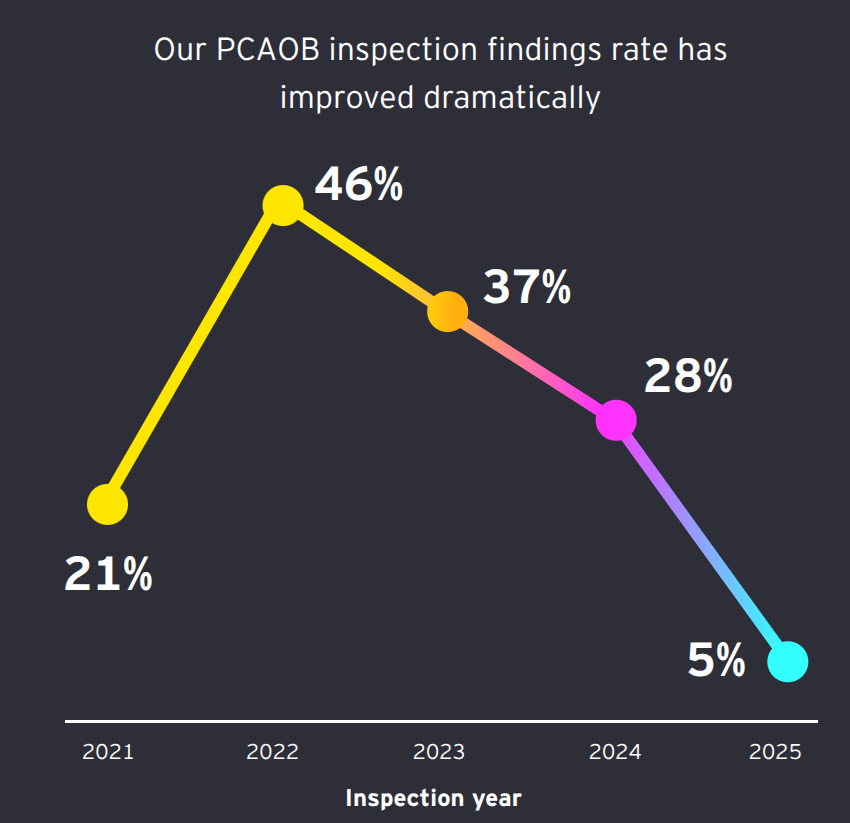
Not sure if “dramatically” is the word we would have chosen, that conveys a theatrical quality rather than a practical one. Drastically? Substantially? Whatever, not our copy to write.
Anyway, Deloitte didn’t have nearly as far to climb as they peaked at 21% in 2023. Still, single digit deficiencies is worth a modest golf clap.
On PwC’s end, they’ve managed to pull fairly steady low deficiency numbers after hitting a high of 30% in 2019. Points for consistency, we suppose.
While KPMG’s 13% is the highest of the Big 4, it too shows a steady improvement for them:
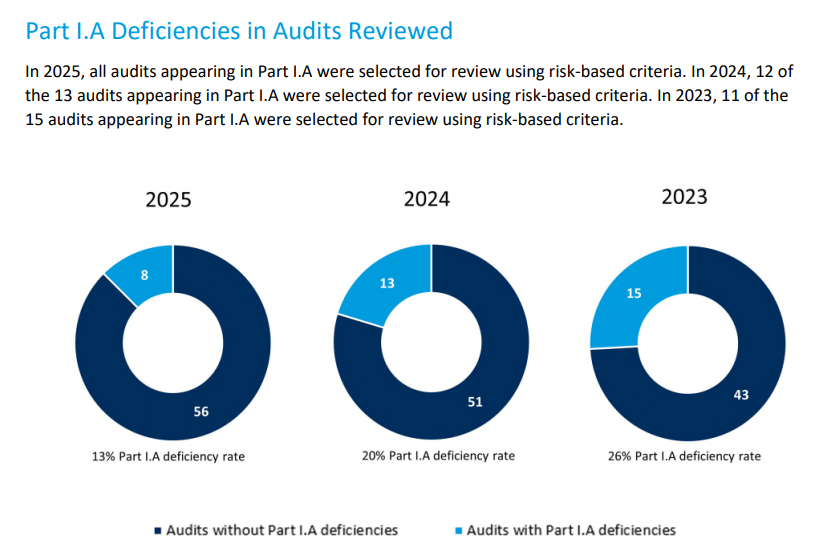
Before we wrap this up can we make a request to the PCAOB? Please make the boxes on these charts bigger, it’s nigh impossible for old eyes to detect these different shades of blue on dirty monitors. Please and thank you.
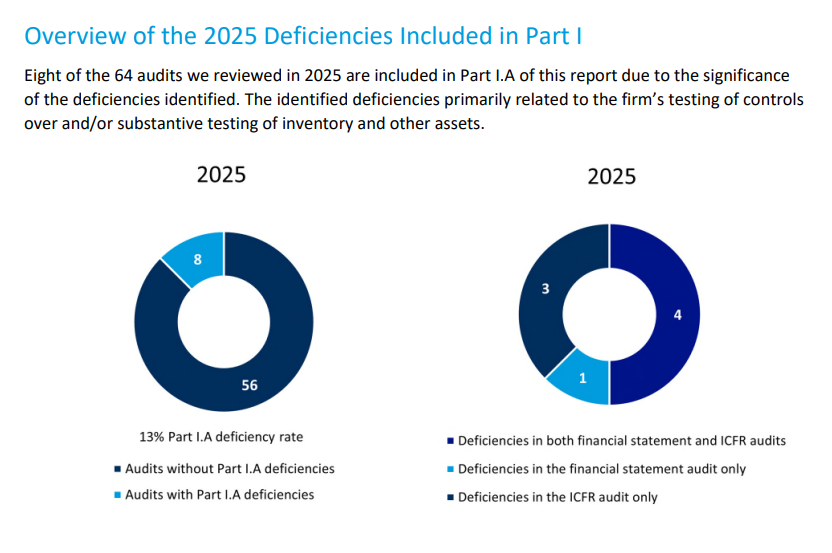
Feel free to discuss your thoughts on firms’ inspection report performance in the comments. Or just complain about PCAOB paper pushing, you can do that too.

Firstly, the ADRs are audits with a deficiency. I previously attacked the calculation for among other things, not being market cap based, Now we have EY fall to a 5% ADR. Really?
The PCAOB’s current chair is a former EY partner.
You don’t suppose? No!
This is such a farce – how many of the “failed” inspections have resulted in a reaudit or a restatement of the financial statements. The answer, I suspect over the past 5 years, is zero. So these “failures” are of an inconsequential matter – and which they deserve attention, they’re of no real consequence to the audited companies. Yes fine the audit partner and those who are responsible – mandatory training, etc., but let’s not suggest that these “failure” result are of substantial importance. If an audit is 99% appropriate, is this “good enough” or do we need to call out the firm and the audit partner.
BDO’s issuer A included a restatement!
I have said things similar to Joe for years.
Suppose we have 60 “marks” for the PCAOB to consider in an inspection.
We have five audits, each with one deficiency. That’s a 98.3% success ratio (295 / 300) with a 100% ADR.
Now we have five other audits, one with 30 deficiencies and the other four with none.
We have a 90% (270 / 300) success rate and an 80% ADR.
Which is worse?
I told Erica Williams this about six years ago.
Nothing has changed.
My mistake, a 20% ADR.