
KPMG has released its AI Quarterly Pulse Survey for Q2 2026 and we’re gonna have to be real with you, it’s all over the place. Not the survey itself, just the responses. If you look beyond the numbers, you can see company leaders settling into the reality of AI rather than scrambling to adopt it just because everyone else is.
Two articles elsewhere — AI bills are baffling the C-suite after shift to usage-based pricing from The Register and Execs Confused and Horrified by the Huge AI Bills After Thinking They Could Replace Workers for Free on Futurism — say outright that the survey report shows leadership bugging out about big AI bills but we aren’t so sure.
Futurism wrote:
By now, it’s clear that the only way the tech industry can justify the cost of AI is if it replaces vast swaths of the human workforce with machines that run 24/7.
The bad news is that this situation has created a world-historic financial market that, by some metrics, is looking worse than the run-up to the Great Depression. The good news is that this future of an AI takeover is looking increasingly unlikely, at least at the industry’s current pace, a fact which is now dawning on some of the biggest rubes and dupes in the corporate world.
According to a new survey from “Big Four” accounting firm KPMG, a significant number of corporate executives are reeling from sticker shock over new usage-based AI pricing schemes. Though enterprises could once count on AI companies to subsidize the price of large language models via flat-rate contracts, that’s no longer a given, as the rising cost of computational power forces the entire tech sector into a defensive posture.
Nice touch there on the air quotes around Big Four. Bet you Futurism doesn’t even know why that’s funny.
Far be it from us to nitpick anyone else’s word choices but we’re not seeing leadership “reeling” in this 8-page report. Two bits from KPMG that do suggest reality is sinking in for them though:
Organizations are confronting an emerging challenge: understanding and managing the cost of operating AI at scale. While many companies have established foundational governance elements such as monitoring dashboards and approval processes, most still lack full, end-to-end visibility into AI related costs in real time.
This gap is becoming more critical as organizations shift from isolated AI use cases to coordinated, enterprise-wide agent deployments.
And:
AI has entered a new phase defined by the shift from scaling adoption to managing execution with greater discipline. Organizations realize that AI is integral to future business viability and growth: deployment is holding steady above 50%, and leaders plan to invest an average of $202 million over the next 12 months.
However, as scale increases a new challenge is emerging: Only 26% of organizations have real-time visibility into the cost of running AI. Disciplined execution is now a core constraint.
Yet, when we dig down toward the end of the survey we see the slide below. If leaders are so worried about costs and benefits, why the hell are so many of them considering toxen-maxxing? (Side note: We are horrified that “maxxing” lingo has made it so mainstream it’s now appearing in Big 4 reports after a brief stop on The New York Times. Please no.)
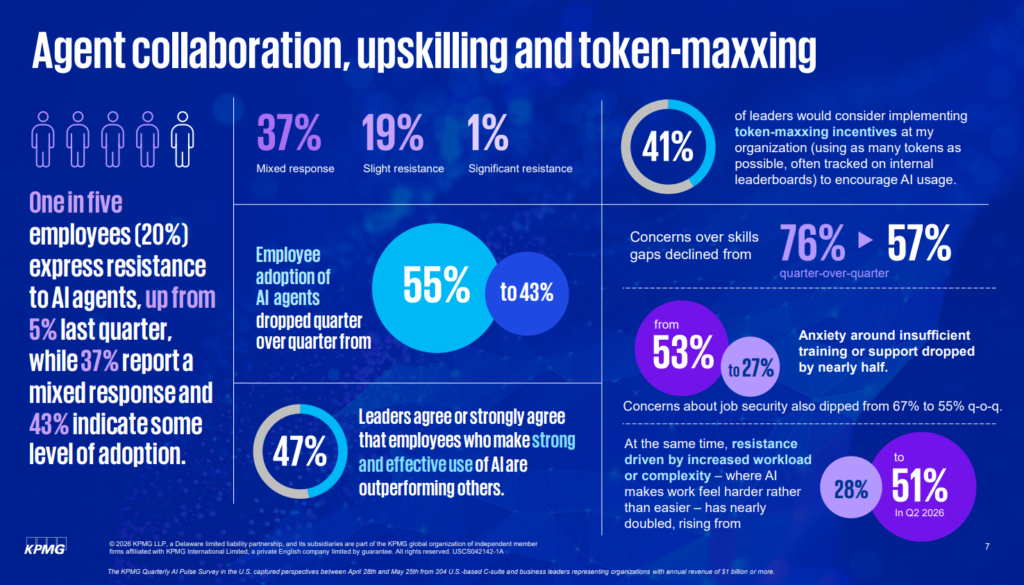
KPMG itself knows all about encouraging AI usage. In May we spoke to a KPMGer about how they and their colleagues are meeting arbitrary AI use requirements at the firm: “Many, including me, would just type random questions into the prompt to hit the once a day quota,” they told us.
Said KPMG in the survey report:
Employee concerns about working with AI agents are shifting with many increasingly feeling the strain of added complexity and workload. At the same time, some organizations are testing incentive models to accelerate adoption, but not all approaches are proving effective. Efforts that prioritize usage metrics over meaningful outcomes risk reinforcing the wrong behaviors.
Like asking Copilot to summarize a two sentence email because mandatory AI usage is now part of your performance rating, eh guys?
Alright, let’s cover one more item and call it a day. Funny how sustainability slipped all the way to the bottom like that. Was nice to know you, ESG.

We’ll be sure to keep an eye out for next quarter’s survey, we have a feeling the numbers will be quite different as AI companies keep turning the vice and start charging for the stuff like it’s AOL circa 1994.

The reaction to AI by Big 4 firms Deloitte, EY, and PWC, as well “Big Four” firm KPMG, is absolutely fascinating to me. As I’ve stated in other posts, the biggest problem with these firms is that they’re being run by accountants. They have a complete lack of vision and imagination. Their response to the emergence of AI has become Exhibit A.
The firms got really excited about AI for two reasons: (1) it may present the opportunity to drastically reduce their headcount, which is literally the most exciting things the partners can imagine, and (2) they’re afraid of being left behind, so they jump on the bandwagon. And boy have they jumped on that bandwagon, to the tune of billions of dollars and counting.
One of the big problems they have, and there are many, is that they don’t have any idea what they can actually do with AI or how it will transform the accounting profession. They’re just making it up as they go along. Flushing spectacular amounts of money down the toilet without a clear plan or vision of the future state. And the funniest part about all of this is that its looking more and more like AI has been drastically overhyped by the big tech companies who are having a harder and harder time justifying the massive losses due to their investments in AI with no profitability in sight. The current partners are literally counting the days until retirement, praying that their firm holds together long enough for them to collect their pensions.