Ed. note: Got a question for the career advice brain trust? Email us at advice@goingconcern.com.
Good afternoon, GCers. No time for small talk. Let’s get to it.
Hi Caleb,
With regards to LinkedIn, do you have any advice on how to request recommendations from superiors, other coworkers, and clients, without giving the impression to my own superiors that I want out? For some background, I am a Senior 3 in EY’s TAS group and have been here since I graduated college.
I like what I do and I work hard to get the job done right, but the double-edged sword of being a “high performer” is that you are continuously staffed on the complex engagements withhat are constantly go-go-go. Needless to say, my social life has become essentially non-existent during the week. I am not actively looking to move to another company given I am up for promotion to Manager this year, but I am starting to think that it would be beneficial from an upward mobility standpoint to make a move elsewhere, and I think getting recommendations on LinkedIn would be a solid start.
Thank you,
J.
J.
Great question. Now, there is no fool-proof way to prevent against raising suspicions, however, you can ask certain colleagues in such a way that will both minimize suspicions and even gain a bit of their respect.
No one knows how LinkedIn will evolve in the coming years. It quickly went from a “why are you on LinkedIn?” website to the year’s biggest tech IPO (for better or worse, but that’s a different story altogether). There’s no denying that recruiters – both headhunters and in-house specialists – use the website as a search tool, so I can understand your desire to beef up your profile. My suggestion is to have recommendations from a peer, a superior, and depending on the relationship, a client. My suggestions for targeting potential rec’s:
1. Superior – The trick here is to pick a superior that is active on LinkedIn. I bet if you searched LinkedIn for the leaders of your group that you’ve worked with, their profiles will fall into one of two categories: a) active or b) dormant. The dormant LinkedIn profile might not show the recent promotion, give little to no description about their practice line or specialties, and they’ll be lucky to have more than 25 connections. The active user (and the person you want to target for a recommendation) will have a very active profile: details about industry knowledge, present title within the firm, probably 100+ connections, and – if you’re lucky – a few recommendations from peers. This is your target.
How to target? Simple. Be honest and straightforward with them in the sense that you are taking your public image within the firm very seriously. You can also mention that LinkedIn is a professional website and you’re hoping to have your hard work properly recognized amongst profiles online; after all, it is a very competitive market within your practice. You can also offer to leave a respectful recommendation on their profile from the perspective of a direct report.
There are two reasons you want to target an active LinkedIn user. First, they know how to use the site, unlike the partner with seven connections who probably doesn’t remember his/her login password. Also, an active user understands the value in having a complete profile. They will likely respect you for taking your public image (and the image of the firm) seriously.
2. Peer – did you and a coworker spear-head a project, push through challenges, and deliver an exceptional product to your clients? There’s nothing wrong with recommending each other’s work. It will demonstrate that you are a team player and work well with those on your level.
3. Client – if you are close with one of your clients, this is a no brainer. Have him/her slap a few nice words on your profile regarding a project or engagement. This will look great on your profile – to both recruiters and your superiors.
The safe, fall back reasoning for pursuing all of these recommendations is that you are hoping to polish up your profile and public image as it is seen within your firm and by your clients. If a recruiter happens to be impressed, so be it. Added bonus.
Has anyone else reached out to one of the groups above? What are your experiences? Share in the comments.


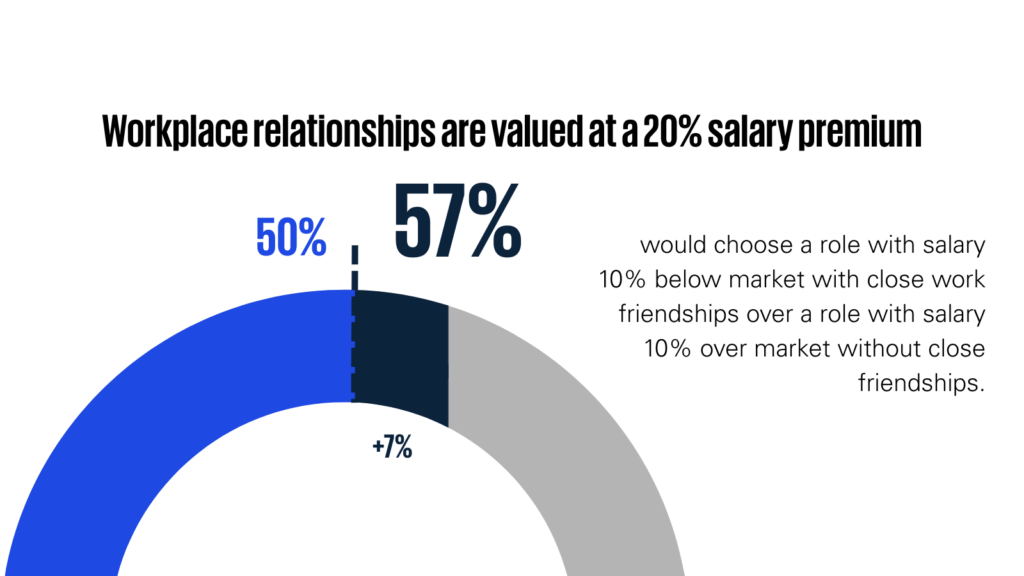
I take a paycut if I do not have to pretend to be friends with coworkers
Sandy forgot to mention our workplace friends in huge numbers who were impacted by US workforce reductions due to Kpmg offshore decisions.
It’s a goofy time for KPMG to post this kind of stuff when all the Big4 Firms are not extending offers to a majority of their interns…in the past you had to really screw up to not get an offer, now it’s like a 95% rejection rate.
I guess everyone just loves working with their offshore counterparts? Hence why the Big4 is hiring so many this year versus US staff because “these kids out of college just suck”…
In case there are any college students out there reading this, the numbers in this are categorically false. It’s true that the 2025 summer class got screwed compared to years past, but the offer rate was still well north of 70%… not 5%. My office was 82%. Also, the firms have “right sized” their internal hiring levels, so the expectation is we’ll be back to near 100% offers.
– a B4 partner
I’m sure it “depends” on the city, group, etc. but I think the acceptance rates are abysmal and the truth is probably between the numbers we are throwing out there…so it’s really bad..
Tagging yourself as “a B4 partner” just tells me you gotta keep saying “everything is fine” so that pipeline is nice and plump even as y’all offshore everything.
So to any college students reading this, it’s probably a good idea to look into another career path while you can.
You can always tell when a KPMG Partner is lying. Their mouth will be moving
So what that really means is you want 20% more to work with the @#$%&es you work with now.