
Hey. 10/15 is behind us and we’re officially a month out from GTA 6, life’s good eh? Have a little news as a treat.
In this news brief
Oh Goodie, More Offshoring
Australian Financial Review got the week started for us with news of layoffs at Deloitte:
Deloitte has cut about 170 jobs in Australia as it shifts roles to its outsourcing division, where it is hiring more than 500 people – targeting stable, recurring revenues, alongside its big four rivals.
The firm wants to triple its outsourcing division, also known as managed services, to generate $1 billion revenue by 2030. That division runs back-office functions including finance, using Australian staff alongside lower-cost hubs such as India.
Let’s make sure we get this bit in too:
Deloitte estimates AI will automate one-third of routine consulting tasks, forcing partners to cut fees by up to 40 per cent.
Yikes.
AI Gets the SOC 2 Treatment
The AICPA has a new hustle and Journal of Accountancy wrote it up:
The AICPA and the Artificial Intelligence Underwriting Company (AIUC) have teamed up to develop an assurance certification that provides the first comprehensive, independent review of business risk related to AI systems and agents.
The joint offering delivers one CPA-led engagement that provides assurance on AI by combining a system and organization controls (SOC 2) report pioneered by the AICPA with an AIUC-1 certification. Last year, more than 40,000 organizations obtained a SOC 2 attestation or AIUC-1 certification, a news release said.
SOC 2 reports are independent examinations performed by a licensed CPA under AICPA attestation standards. The reports, according to the release, are globally recognized for demonstrating that an organization has effective controls to protect data, manage risk, and build stakeholder trust. AIUC-1 certification provides the world’s first standard for AI agent safety, security, and reliability, the release said.
According to the news release, “several CPA firms are now delivering a joint SOC 2® plus AIUC-1 offering to clients. Once initial engagements have concluded, a full launch of the joint certification is expected to take place in early 2027.”
Gemini 4 Argon Isn’t Just Gas When It Comes to Accounting Benchmarks
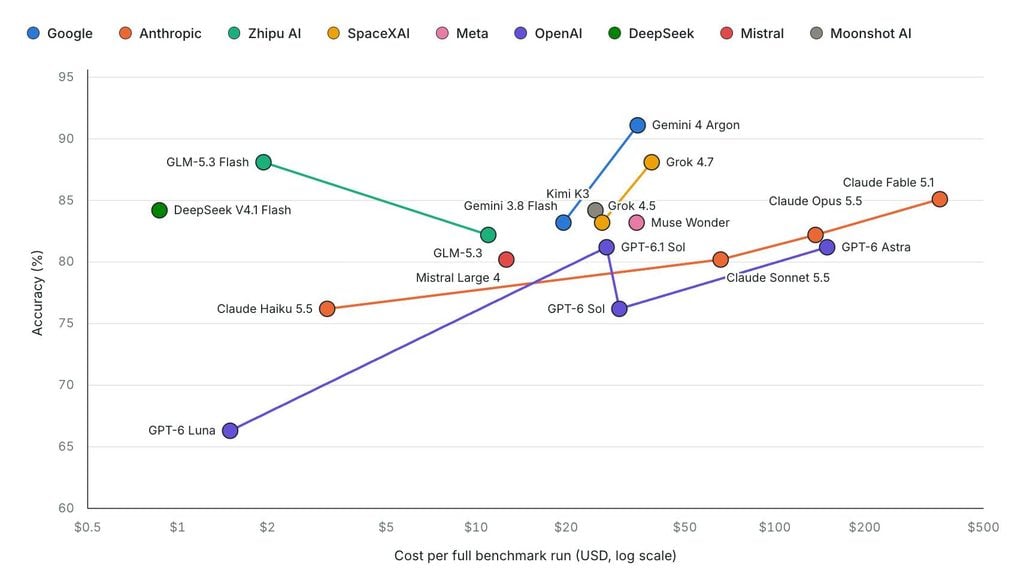
DualEntry says Google’s new frontier model is the strongest accounting model they’ve tested:
Gemini 4 Argon became broadly available on October 13, with Google positioning it for complex, multi-step work across areas including finance, coding, legal, and cybersecurity.
We ran it through the DualEntry Accounting AI Benchmark to see how it actually performs on accounting work. The result: 91.1% accuracy, ranking #1 overall.
It has a weakness though and that’s bank reconciliation.
A chart, if you please:
Who Owns AI Mistakes? (Spoiler: You Do)
A couple of CPAs-slash-associate professors wrote about who’s liable when AI gets it wrong for The Conversation:
AI errors have led to lawsuits, court fines, financial consequences and public embarrassment from fabricated citations, nonexistent sources and inaccurate AI-generated information. These cases raise an increasingly important question: How can professionals benefit from AI without outsourcing the judgment their work requires?
The authors, Kaitlin Newkirk, CPA, MST, M.Acc., and Sarah Webber, CPA, J.D., LL.M., covered an interesting Tax Court case for JofA back in September: A recipe for sanctions: AI-hallucinated citations in tax.
Let’s Panic About AI Like It’s 1999
Here’s a mouthful of a headline from Fortune: KPMG’s CEO on why AI safety isn’t another Y2K and why business leaders are thinking hard about talent right now
I’m sorry, are people actually comparing AI safety to Y2K? That was a much less open-ended problem, with practical solutions. Sure we all held our breath hoping all the preparation was worth it but the point is preparation could and did happen. Anyway…
On New Year’s Eve 1999, while the world waited to see whether the Y2K bug would knock out computer systems at midnight, Tim Walsh was looking at an apartment near Times Square. “Probably not the smartest place to be if the whole world was gonna come to a stop,” he said. Midnight came and went, nothing happened.
Walsh, now KPMG’s U.S. chair and CEO, doesn’t think AI will end the same way. “I don’t think AI is Y2K,” he told Fortune in an interview ahead of the release of the firm’s 2026 U.S. CEO Outlook and what he described as a plethora of conversations about safety and cyber-risk. “Something’s happening and it’s really, really big.”
The article also talks about the kinds of questions he’s hearing about the future of KPMG’s workforce:
At KPMG, he said, the mix of people is what’s changing. A year ago, his interviews opened with some version of the same two questions: When will you cut your workforce by 50%? When will you stop hiring off campus? “Both of those things are absolutely not happening in our business,” he said. “I’m not seeing a significant reduction.”
Again, let’s remember the people first in line to get disappeared by AI are offshore.
Filed Under: Things That Should Have Already Been a Thing
Got one for you fans of IRS regulations:
The IRS finalized regulations (T.D. 10060) implementing changes made by the Taxpayer First Act that would allow taxpayers to make credit and debit card tax payments directly to the IRS rather than through third-party payment processors.
The regulations, issued Friday and scheduled for publication in the Federal Register on Monday, implement changes Congress made in the Taxpayer First Act, P.L. 116-25. Under prior law and regulations, the IRS generally relied on third-party payment processors and was prohibited from paying fees under contracts related to accepting credit and debit card tax payments.
That’s all she wrote for this news brief. If you have a tip or story for us get in touch via email or text. Later, gators.