
The comment period for PCAOB Release No. 2026-005 Request for Public Comment on PCAOB Standard Setting has closed and when all was said and done, it racked up an unremarkable 33 comments. The request asked for input on a few matters the PCAOB would focus on for research and standard setting: Data and Technology, Fraud, Critical Audit Matters, Noncompliance with Laws and Regulations, Firm and Engagement Performance Metrics, and Auditor Independence. For the sake of this article not running 25,000 words, we’re going to focus on the Data and Technology (read: AI) portion of comments made by the four firms with the most pull. And even that’s going to be long, sorry. TLDR: Firms generally support a focus on data and technology, particularly AI, and are supportive of the formation of an AI task force but caution against whipping up specific AI standards given the rapid change forces at work currently.
First, special shout-out to Jim here who was first to submit comment and had a lot to say about the CCP.
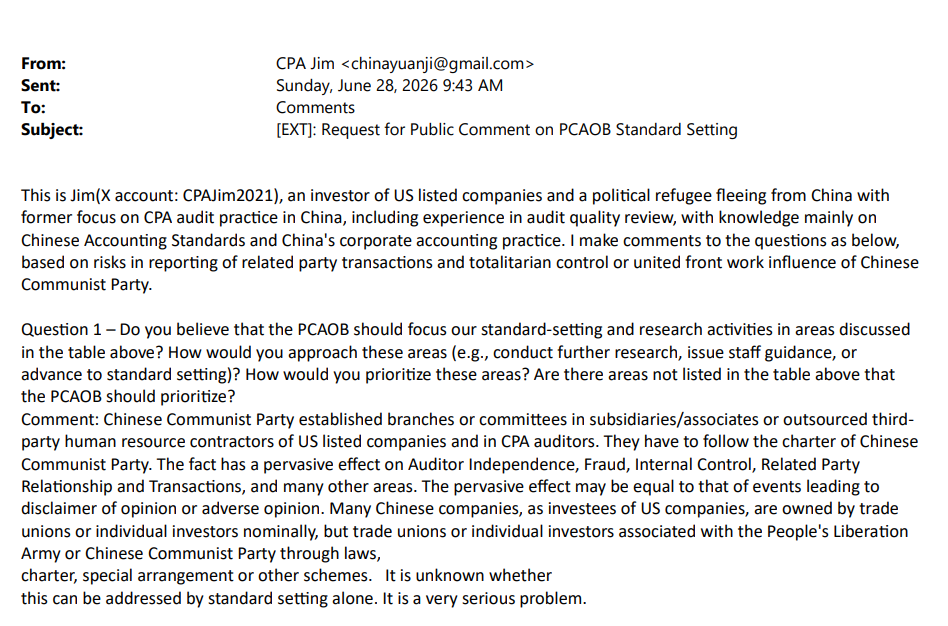
Moving on, PwC was the first of the Big 4 to get their comment in:
The use of AI by companies and auditors should be the board’s foremost priority.
The use of AI by companies and auditors should be the board’s foremost priority. We strongly support the PCAOB’s stated intent to address the use of AI, in particular Generative AI (GenAI), and other emerging technologies in financial reporting and the audit process. In the short term, we recommend the PCAOB issue guidance to raise awareness and provide clarity in the application of the PCAOB’s professional standards given the broad, varied, and rapidly evolving use of advanced technology, including AI, impacting the audit.
Over the longer term, the board may find it appropriate to propose changes to its auditing and quality control standards or explore other mechanisms to integrate guidance explaining how those standards are expected to be applied as technology advances. We recommend the PCAOB form an AI task force, seek deeper engagement with firms of all sizes, and coordinate with its inspections personnel to inform its longer-term efforts.
A couple excerpts from EY’s 17 pages:
Additionally, while data and technology, including artificial intelligence and digital assets, should remain a strategic focus area, we do not believe broad or prescriptive standard setting is warranted at this time. Given the rapid pace of technological change, the Board should continue its research and monitoring activities and leverage stakeholder outreach, inspection observations, interpretive guidance and the consultation process to promote consistent application of existing principles-based standards.
We believe that developing premature or overly prescriptive standards could create unintended consequences and hinder innovation that might otherwise enhance audit quality. Given the importance of this area for all relevant standard setters globally, we also encourage the PCAOB to actively engage with standard setters such as the American Institute of Certified Public Accountants (AICPA), International Auditing and Assurance Standards Board (IAASB), and the International Ethics Standards Board for Accountants (IESBA) as they monitor developments in data and technology.
And:
We support the PCAOB’s commitment to protect audit quality by promoting greater understanding across the profession about how data and technology are used and encountered in the audit. We believe it is important that the Board continue to actively monitor and research the evolution of data and technology, including artificial intelligence and digital assets. As part of these efforts, the PCAOB should continue to engage with the AICPA, IAASB and IESBA on their technology-related activities to provide perspectives from the US capital markets and consider what these activities could mean for the PCAOB’s standard-setting agenda.
We would caution the Board to avoid preemptive or prescriptive standard setting related to emerging technologies. Instead, we recommend the Board focus on how the concepts in existing principles based standards apply in the current environment of rapid change. If the Board identifies potential threats to audit quality or areas of inconsistent application and interpretation across firms through monitoring and research activities, including stakeholder engagement, inspections and the new consultation program, we believe it would be most effective in the near term for the PCAOB to consider timely interpretive guidance. If the Board acts prematurely to address emerging technology issues through standard setting, it risks creating unintended consequences and potentially hindering innovation that could otherwise enhance audit quality.
Deloitte talked a lot about its “support for global alignment” throughout its 10-page submission:
An important and time-sensitive opportunity exists for greater engagement on the impact of emerging technology, including artificial intelligence (AI), on an audit. We acknowledge the participation of the PCAOB and the SEC on the IAASB’s Technology Quality Management Expert Panel as an important step toward coordination and sharing perspectives on a paradigm-shifting topic affecting the entire corporate reporting ecosystem. We believe that additional opportunities may exist to consider how the PCAOB’s project on data and technology may be integrated with similar activities the IAASB is considering in this emerging space.
And:
Technology, including AI. Addressing the implications of evolving technology, including AI, is among the most consequential items on the Board’s agenda, and we encourage the Board to prioritize it accordingly, consistent with our recommendation to consider the IAASB’s standards as a baseline for PCAOB standard setting. The pace of change makes sequencing and discipline essential; moving too quickly risks requirements too narrow or prescriptive to remain fit for purpose, while moving too slowly leaves auditors without the guidance they need in a rapidly evolving environment. We recommend the Board approach this topic in two phases.
Near term, the Board’s priority should be to deepen its understanding of how AI is being deployed by issuers in financial reporting and internal control and by auditors in performing audits, and translate that understanding into practical guidance for auditors (e.g., staff guidance, practical aids, or spotlight publications). The PCAOB’s research project on data and technology should draw substantially on the IAASB’s Technology Quality Management initiative, alongside what the Board observes through inspections and direct engagement with firms on the tools and governance frameworks they use. To bring rigor and breadth to this effort, we encourage the Board to convene a formal advisory group of issuers; auditors; and technology, data science, and AI governance specialists (consistent with our recommendation in response to the Strategic Priorities RPC), with attention to areas in which U.S. specific considerations may warrant a different approach. Staff guidance from this process would give auditors a practical framework for AI-related issues without establishing requirements before the landscape is sufficiently understood.
Because the auditor’s work follows from the frameworks issuers apply, coordinated guidance addressing both management’s responsibilities in deploying AI and auditors’ corresponding considerations would set clearer expectations for both parties from the outset. We encourage the Board to engage with the SEC, given the mutual benefit of coordinated action.
Longer term, the Board should take a holistic view of how its standards need to evolve in an increasingly technology-enabled environment. The PCAOB’s principles-based standards largely accommodate technology developments, including AI, at the conceptual level, but some areas may need more specific guidance or, ultimately, targeted standard changes to ensure consistent auditor execution. Before concluding where and how to act, the Board should research where the most significant gaps exist, taking into account those the IAASB has already identified. Using staff guidance to meet near-term needs while standards are developed deliberately, and in alignment with the IAASB, will produce more durable outcomes than fragmented, simultaneous standard setting across numerous areas.
Rounding out fourth we have KPMG with a whopping 23 pages:
This topic [Data and technology] is the area with the highest priority. Given the rapid pace of change and the broad range of technology affecting the financial reporting ecosystem, the central focus when modernizing and updating existing standards and developing new requirements should be on monitoring developments, identifying emerging risks and opportunities, and determining where additional clarity may be needed over time.
In the very near term, staff guidance, supported by continued research and monitoring, is preferable to standard setting. We suggest guidance in this area address how auditors should apply existing standards when using technology-assisted tools, AI, automated procedures, and externally generated or modelbased information, which could also increase the consistency in application of existing standards across the profession and alignment of audit execution with the Board’s expectations.
And:
We support the Board’s continued focus on technology, including artificial intelligence (AI), as an area of strategic importance to the audit profession and the broader financial reporting ecosystem. The rapid evolution and increasing use of AI across the financial reporting landscape heightens the importance of a thoughtful, agile, and forward-looking approach to standard setting that both promotes audit quality and enables responsible innovation.
At the same time, the breadth, complexity, and pace of change associated with AI present unique challenges for traditional standard-setting processes. AI is not a discrete topic that can be addressed through a single, comprehensive rulemaking effort; rather, it is a cross-cutting capability that impacts multiple aspects of financial reporting and auditing.
Establishment of an AI Task Force
The PCAOB should focus its data and technology research project on the implications of AI for the audit profession. While research will be a critical, foundational component for any future PCAOB actions in this area, the project should be supported by clear objectives and a structured plan to ensure meaningful progress in a rapidly evolving environment. The project should include ongoing engagement with key stakeholders, including investors, preparers, audit committees, auditors, technology providers, academics, and other standard setters and regulators to identify emerging risks, opportunities, and areas where existing requirements may require clarification or enhancement. The results of this work could inform future guidance, targeted standard setting activities, and other regulatory responses as AI adoption and use cases continue to mature.
Before we wrap this up, honorable mention goes to the AICPA who said in their letter that the PCAOB should consider issuing staff guidance rather than standards on certain topics, including how “existing requirements apply to new circumstances, such as technology-enabled and AI-assisted procedures.” Why reinvent the wheel and all that.
All 33 letters can be found here if you’re having trouble sleeping later tonight. And keep an eye on the PCAOB data and technology page, which last got a new spotlight back in 2024.