

Although the IRS headcount has been slashed by 25%, thankfully there are still enough of them left over there to get this year’s Dirty Dozen list out. If you don’t know, and if it isn’t evident by its name, the Dirty Dozen list covers the hot scams both taxpayers and practitioners should be on the lookout for this filing season.
Although IRS CEO Frank J. Bisignano said in the news release that the IRS uses the Dirty Dozen list “to flag emerging scams that taxpayers should watch out for,” many of these are recurring issues that continue to plague both taxpayer and tax collector alike. We’ll include 2025’s list at the bottom of this article so you can compare if you truly have nothing better to do with your time today.
And now, the 2026 Dirty Dozen list, as numbered by the IRS:
1. IRS impersonation by email and text (phishing + smishing)
THE IRS DOES NOT TEXT YOU RANDOMLY NOR WILL AGENTS WITH HEAVY ACCENTS CALL YOU DEMANDING PAYMENT IN GOOGLE GIFT CARDS. Just had to get that out of the way. Thanks to AI, scammers’ heavy accents may soon be a thing of the past which brings us to the second item on the list.
2. AI-enabled IRS impersonation by phone (robocalls, voice mimicry, spoofed caller ID)
Yep, we’re here. This is what the IRS said about AI-enabled IRS impersonation:
Phone scams continue to evolve, including calls that use computer-generated tactics and spoofed caller ID to appear legitimate. The IRS reminds taxpayers that it generally contacts taxpayers by mail first and does not leave urgent, threatening prerecorded messages, call to demand immediate payment, or threaten arrest. Taxpayers should not rely on AI-generated responses to complex tax questions, and they should verify any calculations or information provided by artificial intelligence.
So pretty much just like item number one except now they can do it on an even bigger scale, with more sophisticated technology, thanks to AI. Don’t you love the future?
3. Fake charities
The IRS reminds us that money or goods given to charity can be deducted from your taxes but only if you itemize and only if it’s a registered non-profit. Before you give, you can check the organization with the IRS tax exempt search tool here. Kind of fun to dig through 990s and see how much executives at certain non-profits are paid too but we won’t tell you what to do with your generosity.
4. Misleading tax advice on social media
Oh, TikTok. Bad and downright fraudulent tax advice continues to run rampant on social media. But you, dear reader, are an intelligent professional and won’t fall for it surely.
5. Identity theft involving IRS Online Account access
With data breaches now a common occurrence in this digital nightmare of ours, the IRS has once again reminded taxpayers to guard their IRS online accounts. They said:
Criminals may attempt to use stolen personal information to gain unauthorized access to a taxpayer’s IRS online account or may pose as helpers to collect sensitive information during account setup. Taxpayers should create their account directly through IRS.gov and should not rely on unsolicited third parties offering assistance. The IRS provides official guidance to help taxpayers securely establish and protect their accounts.
6. Abusive undistributed long-term capital gains claims
This one’s new! Said the IRS:
The IRS identified an increase in the abuse of Form 2439. This form allows shareholders of certain investment funds or real estate trusts to claim a refundable credit for taxes paid on undistributed capital gains. Identified schemes involve overstated or fabricated Form 2439 claims, including claims tied to organizations that are not legitimate investment funds or real estate trusts. The IRS has also seen fake claims falsely linked to real, well-known organizations. Improper claims may result in refund delays, audits, penalties, or enforcement action.
7. Bogus “Self-Employment Tax Credit” promotion
Social media at it again with this one. If you get your tax advice from TikTok read this sentence from the IRS carefully: “Many taxpayers do not qualify for these credits, and the IRS is closely reviewing claims coming in under this provision, so taxpayers filing claims do so at their own risk.”
8. Ghost preparers
Ghost preparers are people who will prepare your return but aren’t responsible for it because they refuse to provide a PTIN and/or sign it.
9. Non-cash charitable contribution schemes
This one is a warning not to use inflated appraisals of donated property using syndicated conservation easements or art. If you claim you donated a $2 million painting, the IRS is probably gonna say something unless you’re a society name often described as a philanthropist when the local paper writes about you.
10. Overstated withholding schemes (fabricated wage/withholding data)
The IRS says that “other withholding” schemes often involve the following: Forms W-2 and W-2G; Forms 1099-R, 1099-NEC, 1099-DIV, 1099-OID, and 1099-B, as well as the Alaska Permanent Fund Dividend, Schedule K-1 with Withholding Reported, and Unspecified Source of Withholding Credit Claimed. So we can take that to mean they’re looking at these a little more closely.
11. Spear-phishing and malware campaigns targeting tax professionals
The only Dirty Dozen item aimed specifically at tax practitioners, we’re sure all of you have been targets of this at some point. We even get emails from these scammers in our editor box. Here’s one we got last year:
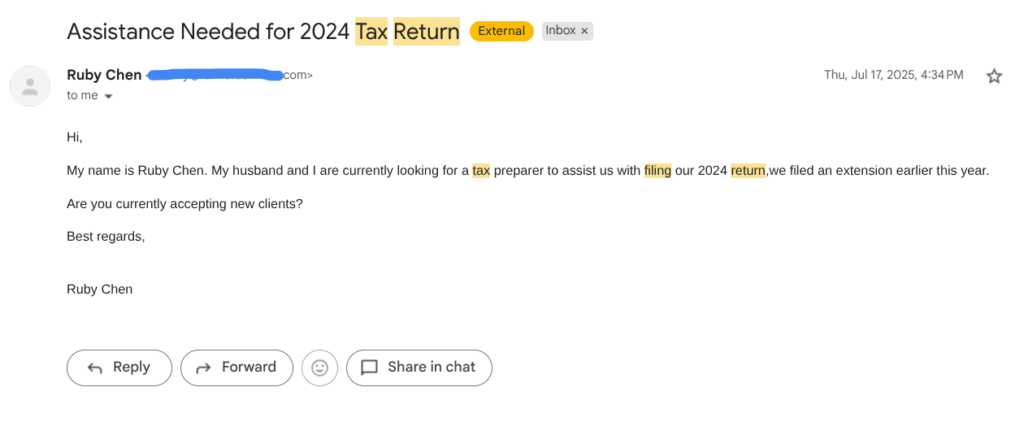
That one was pretty basic and we can only tell it’s a scammer because who the hell would ask an accounting tabloid to do their taxes? Plus the email didn’t match the name. We’ve also gotten a bunch of these with attachments, those tend to come with more scammer tells than the above.
So be careful. They tend to pop up more after April 15 for some reason. Kind of funny to think about scammers having a schedule that recognizes tax preparers aren’t taking on new clients in the middle of filing season.
12. Aggressive or misleading Offer in Compromise marketing (“OIC mills”)
For this one we’ll just say be wary of high-pressure sales tactics (not to be confused with “weary” which is what tax professionals are). It was true for the ERC mills and it’s true for the most aggressive tax resolution shops. Do your homework, know what you’re getting into before you get into it.
And that’s it for 2026! Be safe out there, everyone.
2025 Dirty Dozen
- Email phishing scams
- Bad social media advice
- IRS Individual Online Account help from scammers
- Fake charities
- False Fuel Tax Credit claims
- Credits for Sick Leave and Family Leave
- Bogus self-employment tax credit
- Improper household employment taxes
- The overstated withholding scam
- Misleading Offers in Compromise
- Ghost tax return preparers
- New client scams and spear phishing
Very interesting article, Been receiving so many Spear-phishing emails and i would have fallen for some if it was not me being busy. Thank you for this insight