

In the final ruling of a game of semantics that really chapped the AICPA’s ass, accounting has not earned a place on the Department of Education list of “professional” degrees. As discussed in previous articles, all this means is that federal student loan borrowing for graduate accounting degrees is capped at $20,500 a year and $100,000 total. It does NOT mean that the Department of Education is saying that accounting or any other profession not on its list of 11 “professional” degrees is not actually professional.
Earlier coverage to get you caught up:
- The AICPA Gets the “Professional” Validation They Wanted, Early Career Pipeline Still on Fire (February 3, 2026)
- Accountants Inexplicably Deemed “Not Professional” Under OBBBA Student Loan Rules (November 21, 2025)
Due to receiving a ton of backlash from excluded professions — namely nursing but we’ll say the AICPA’s strongly worded letter may have had some effect as well — the Dept of Ed conceded that exclusion from the professional degrees list is not intended to imply that excluded professions are not professional. Which any reasonable person would have concluded from the beginning but whatever. They put this in the Federal Register in February:
The department notes that the term ‘professional student’ as used in this [NPRM] is intended solely to distinguish those programs that we propose would be eligible for higher loan limits, as required by [the One Big Beautiful Bill Act]. The designation, or lack thereof, of a program as ‘professional’ does not reflect a value judgment by the department regarding whether a borrower graduating from the program is considered a ‘professional.’ This NPRM only interprets the phrase ‘professional student’ as used in the context of the loan limits established by [OBBBA].
The final rule, which is effective July 1, describes the breadth of comments the Department of Education received specifically regarding accounting:
A subset of commenters urged the Department to treat accounting pathways, particularly those intended to prepare students for CPA licensure, like other included professional programs. These commenters emphasized public protection responsibilities, ethical obligations, State licensure requirements, and the central role of CPAs in attestation, auditing, tax, and financial reporting. Several State CPA societies argued that graduate accounting programs remain a critical and widely used route to CPA licensure, even where States now provide more than one educational pathway. For example, commenters emphasized that their State allows either a bachelor’s degree plus two years of experience, or a master’s degree plus one year of experience, both coupled with the passage of the Uniform CPA Examination and satisfaction of ethics and competency standards as pathways to licensure.
Other commenters argued that even where a master’s degree is not universally required, accounting should still qualify, as graduate study is often the practical route to meet the 150-credit hour expectation, the profession is heavily regulated, and the work implicates public trust and economic stability. Some commenters also urged the Department to either include accounting expressly or to retain non-exclusive phrasing that would preserve flexibility for inclusion of accounting and similarly situated programs.
Here’s their reply to that:
The Department also disagrees with commenters that advanced accounting degrees beyond the baccalaureate level should be considered professional degrees. As the commenters themselves concede, these master’s degrees are not required, in general, to become a Certified Public Accountant (CPA). Even though students must have completed 150-credit hours or 225 quarter hours to sit for the Uniform CPA Examination, there is no specific requirement to earn a master’s degree. In other words, the master’s degree does not signify the beginning of practice in a given profession, because earning 150 credit hours is the primary determinate. In general, undergraduate accounting students can take all of the requisite coursework required to sit for the exam as part of their baccalaureate coursework, although the Department acknowledges that most institutions require less than 150 credit hours to graduate.
Feel free to discuss in the comments or we can just move on from this and focus on things that actually matter, such as the same people who complained about this actively watering down the value of the profession. See comments on the last post:
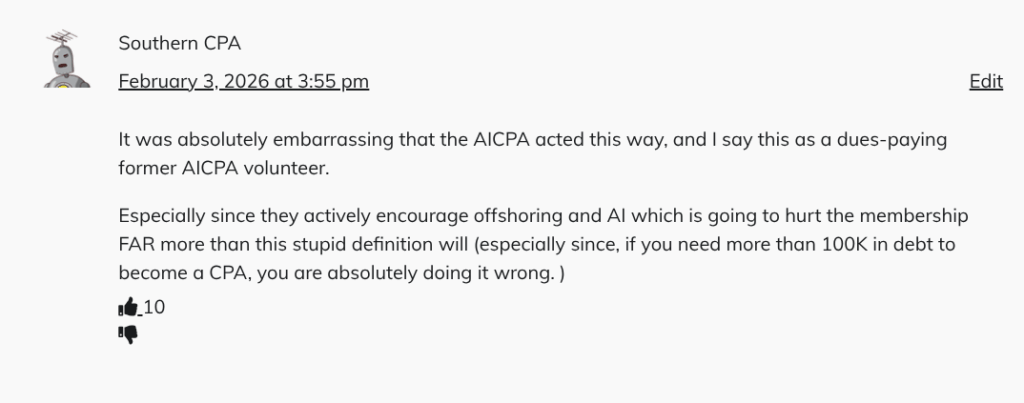


This is actually GOOD news. There’s no reason whatsoever to spend more than the annual or total “cap” to become a CPA.