

If you’ve been keeping track of the push for alternate pathways to CPA licensure that started in earnest two years ago when Minnesota decided to start beef with the AICPA over it, you know that a lot has changed in those two years. There was a flurry of activity in state houses across the country last year and we’re now at almost half of jurisdictions having changed their rules with more expected to follow.
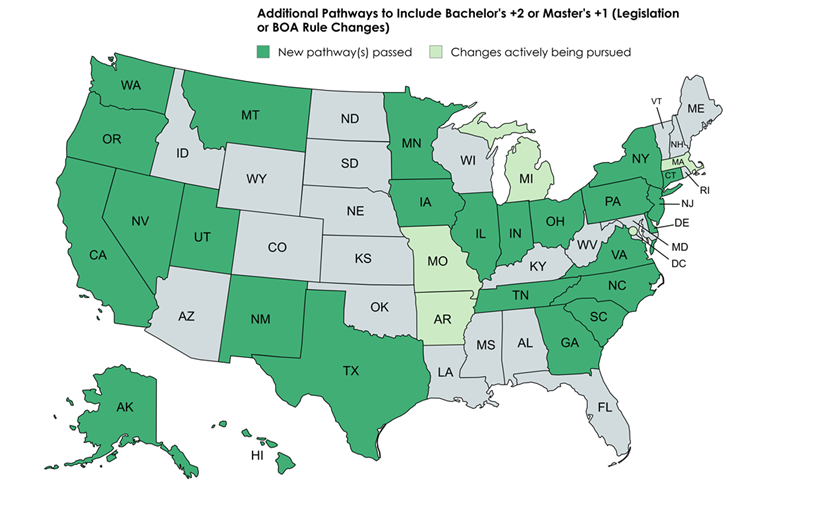
By the end of 2025, NASBA had updated the Uniform Accountancy Act (UAA) to allow for three pathways:
- Graduate Degree Pathway: Graduate degree in accounting + one (1) year of professional experience + passing the CPA Exam.
- Traditional 150-Hour Pathway: Bachelor’s degree in accounting + 30 additional semester credits (total 150 semester hours) + one (1) year of experience + passing the CPA Exam.
- New 120-Hour Pathway: Bachelor’s degree in accounting (120 semester hours) + two (2) years of professional experience + passing the CPA Exam.
You’ll note that state-level rules may differ from what’s laid out here because the CPA exam is mainly a test of fortitude and they have to test how committed you are to this by making it as annoying as possible (jk TPTB, we know you aren’t that evil. I think).
For anyone who may be confused about which states changed over to new pathway rules when the clock struck midnight on January 1, 2026, we’ve compiled a list. Several other states had earlier or later effective dates, like California, Indiana, and Illinois whose licensure changes don’t take effect until January of 2027, these are just the ones that took effect on January 1 of this year.
- Alaska
- Georgia
- Minnesota
- Montana
- New Mexico
- North Carolina
- Ohio
- Oregon
- Tennessee
- Virginia
If you are sitting for the CPA exam in the next couple years it’s imperative that you review the requirements in your state and find out if changes have happened or are expected to happen by the time you will seek licensure. As always, the exam itself is the only thing that is 100% uniform across jurisdictions and each jurisdiction may have different rules and regs. In normal times these rules tend to align across the board but we’re in a period of swift upheaval.
See what you started, Minnesota? Good job.
Adding the 5th year of school and removing the 2nd year of experience was an obvious blunder unless your goal is to complain about the lack of accounting majors in the US so you can send more work offshore. It’s a bit sickening to think how much of my AICPA dues revenue went toward defending this abject failure of a policy which was so clearly counter to the interests of the vast majority of US CPAs. The only question remaining is why there are still 20 states who haven’t changed yet.
What nobody seems to be addressing is the probable loss of a required ethics/accounting ethics course as part of the extra 30-units, the completion of which is now optional. In California, a state that had a 10-unit ethics requirement, it’s probable that many universities will drop the requirement for ethics entirely. Cal Poly San Luis Obispo, where I taught for 10-years, eliminated the accounting ethics course, which was a requirement in the BS program, and deleted it from the catalog entirely. It can’t even be taken as an elective. This is a shame given the continued violations of professional ethics. Ironically, one example is that the Big 4 firms experienced cheating by staff on internal training CPE courses, one course of which was ethics!
Good to see you, Steven! I haven’t seen much if any discussion around that, definitely something worth talking about. I’ma shoot you an email, I’m thinking it deserves its own article.